Parkinson Voice Project®
Certified SPEAK OUT!® Provider — evidence-based therapy helping people with Parkinson's and related disorders regain and retain their speech and swallowing.
SPEAK OUT!® is a structured therapy program for people with Parkinson’s and related disorders — combining individual therapy, daily home practice, weekly group classes, and ongoing refreshers.
The Circle of INTENT below shows how each stage fits together.
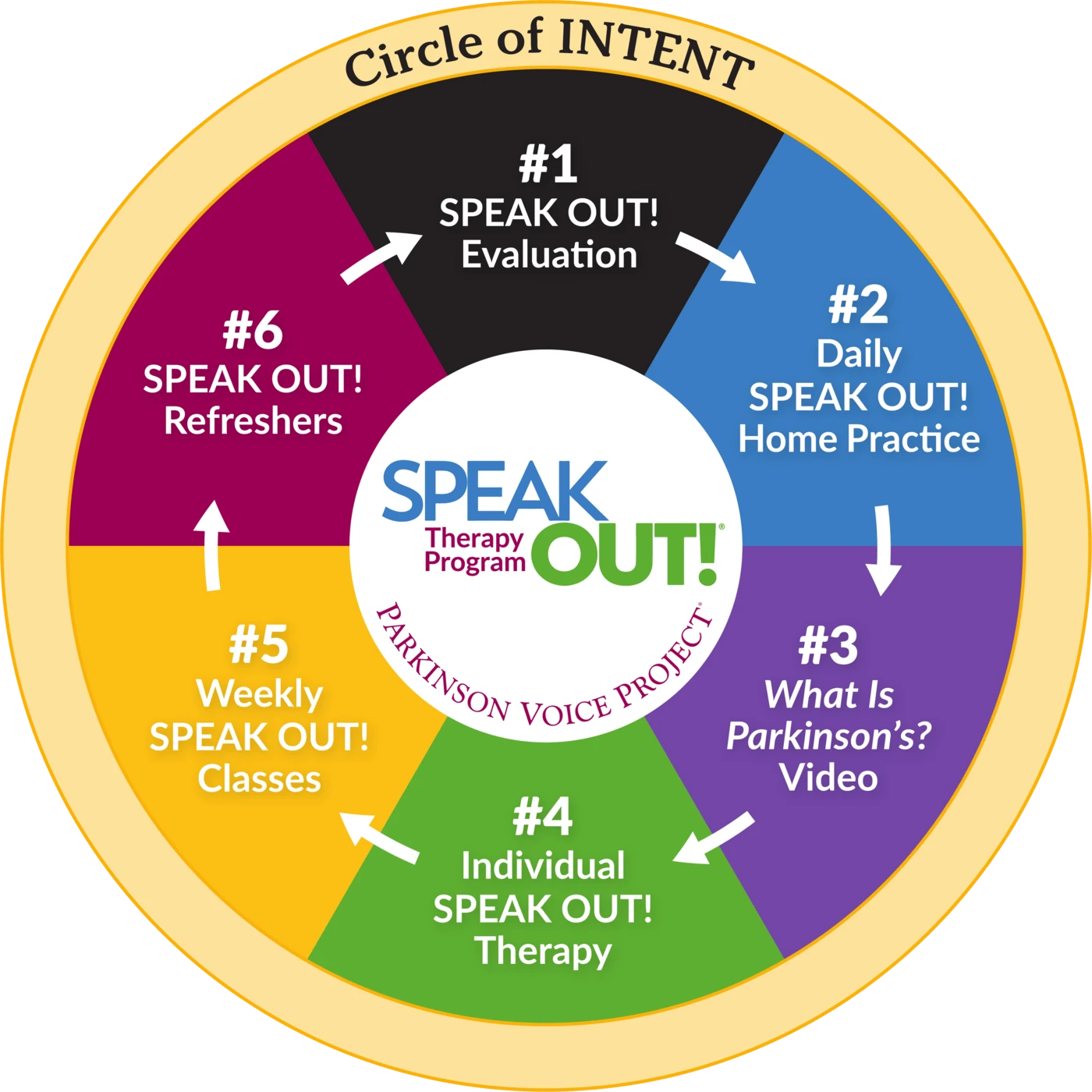
Click any step below to read more.
SPEAK OUT!® Evaluation
Daily SPEAK OUT!® Home Practice
What Is Parkinson's? Video
Individual SPEAK OUT!® Therapy
Weekly SPEAK OUT!® Classes
SPEAK OUT!® Refreshers
The SPEAK OUT!® Therapy Program, developed by the nonprofit organisation Parkinson Voice Project®, helps people with Parkinson’s and related disorders regain and retain their speech and swallowing. The program can improve volume, articulation, breath support for speech, vocal quality, intonation, and facial expression. Patients and families also report reduced drooling and improved swallowing.
This highly effective, research-based treatment combines education, individual SPEAK OUT! Therapy, SPEAK OUT! Classes, daily home practice, and continuous follow-ups. Once patients enter the program, they remain in it for life. Patients are empowered to “speak with INTENT,” transitioning speech from an automatic function to an intentional act.
“Up to 90% of people with Parkinson’s are at risk of losing their ability to speak. In addition, swallowing complications account for 70% of the mortality rate in this patient population.”
— Parkinson Voice Project
Why Speaking with INTENT Works
Parkinson’s affects the part of the brain that controls automatic movement — the things you do without thinking. Walking. Chewing. The natural rise and fall of your voice during a conversation. As Parkinson’s progresses, these automatic systems get weaker. That’s why speech can become softer, flatter, and harder for others to hear.
But there is a second pathway in the brain. One that controls deliberate, intentional movement. That pathway is largely untouched by Parkinson’s.
SPEAK OUT!® works by moving speech from the automatic system in the brain to the intentional system. This is done by using the technique of INTENT. Instead of letting your voice rely on the weakened automatic system, you learn to use the intentional system by being deliberate and intentional. In turn, your voice becomes louder, clearer, and more expressive.
Where “speak with INTENT” comes from
In the 1950s, speech pathologist Dr Daniel Boone noticed something unusual in his patients with Parkinson’s.
When he asked them to count forwards — 1, 2, 3 — their voices were quiet and mumbled. When he asked the same patients to count backwards— 10, 9, 8 — they spoke remarkably louder and clearer.
Nothing about their voices had changed. What had changed was their attention. Counting backwards took deliberation — and that deliberation recruited a different pathway in the brain, one that Parkinson’s hadn’t damaged.
That single observation is the foundation of SPEAK OUT!®. In 2010, Dr Boone worked with the Parkinson Voice Project to formalise it into the structured program now delivered worldwide.
Who Is This For?
SPEAK OUT!® is designed for people with Parkinson’s disease and related disorders who are experiencing changes in their speech, voice, or swallowing. It’s suitable for people at various stages of the condition.
Beyond Parkinson’s Disease
Although SPEAK OUT!® was developed for people with Parkinson’s, it is also relevant for those living with other neurological conditions, such as:
So if you or someone you care for is living with Parkinson’s, a Parkinson’s Plus syndrome, or any other neurological condition, please get in touch with us. The journey does not have to be a lonely one. We are here to support you or your loved one with all of your communication needs.
When Should You Start?
The earlier the better.
SPEAK OUT!® is effective at all stages of a condition’s progression, however early intervention is highly recommended in order to help a person regain and retain their speech, voice, and swallow.
Signs for early intervention:
One important thing to know: due to a sensory deficit, people with Parkinson’s often can’t hear their own voice changes accurately. The same changes that affect how you produce voice also affect how you perceive it. Many people feel they’re speaking at normal volume while those around them are straining to hear.
If someone close to you has mentioned your voice is sounding different, it’s worth trusting their perception and getting an assessment. The sooner we start, the more we can maintain.
What the Research Shows
SPEAK OUT!® has been studied in peer-reviewed research over the last decade. In a 2020 study of 40 people with Parkinson’s, published in the American Journal of Speech-Language Pathology:
- Voice volume increased by around 8 decibels on average — an audible, meaningful change.
- Voice quality after treatment was equivalent to that of healthy adults of the same age.
- The natural rise and fall of speech — which Parkinson’s flattens — returned toward normal.
- Quality-of-life scores improved significantly.
A 2022 follow-up study found that these improvements were maintained twelve months later— but only in people who kept attending weekly SPEAK OUT!® Classes. Daily home practice and weekly group contact are what hold the gains in place over time.
More recent research, published in 2024, confirmed similar results when the program is delivered online via video call — not just in person.
Plain English version: the program works, the improvements are measurable, and — if you keep up with the practice and the group — they last.
How the Program Works
What a session looks like
Following initial assessment, each therapy session runs for approximately 45 minutes. We’ll move through a vocal warm-up, sustained vowel exercises, smooth and connected counting, reading aloud, conversational practice, and cognitive tasks.
During the program, two daily home practice sessions are required and should take approximately 20 minutes to complete.
Why This Helps Swallowing Too
Voice and swallowing use almost the same muscles. The same vocal folds that close when you speak are the ones that close to keep food and drink out of your airway when you swallow. The same breath support that carries your voice powers a strong, protective cough.
Parkinson’s weakens both at the same time, through the same underlying mechanism. So when SPEAK OUT!® strengthens the muscles and pathways used for voice, swallowing tends to improve alongside — often without needing to be worked on directly.
People and their families often report:
For people with Parkinson’s, safer swallowing is a meaningful outcome — swallowing difficulties are the leading cause of serious illness in this group. Looking after the speech and voice helps look after the swallow.
About Parkinson Voice Project
Parkinson Voice Project is a 501(c)(3) nonprofit organisation solely dedicated to helping people with Parkinson’s and related disorders regain and retain their speech and swallowing. The organisation has trained over 11,500 SLPs and 16,600 students in more than 50 countries.
Edwina Kruizinga is a Certified SPEAK OUT!® Provider, delivering the full program with fidelity to the evidence-based model at Sunshine Beach Speech Pathology.
For Partners, Family, and Referrers
If you’re reading this because someone in your life has Parkinson’s, and you’ve noticed their voice changing — you’re probably the person best placed to raise it.
People with Parkinson’s often can’t hear their own voice changes as they happen. They may feel they’re still speaking normally while you’re straining to follow. This isn’t stubbornness; it’s a real part of how the disease affects the sensory feedback loop.
The most helpful thing you can do is gently suggest an assessment — and, if they’d like, come along. Many of our clients find it easier to engage when a family member is involved from the start. The home-practice routine also tends to stick better when someone at home knows what the program is and can share the encouragement.
For GPs, geriatricians, neurologists, and Parkinson’s nurses: referrals are welcome at any stage after diagnosis. I work closely with multidisciplinary teams and can provide written updates as needed. There’s no waiting period and no minimum severity — earlier engagement gives better long-term outcomes.
“Edwina you are a beacon of light amongst a sea of Parkinson’s sufferers, keep up the excellent work.”
Interested in SPEAK OUT!®?
If you or someone you know is living with Parkinson's, we'd love to discuss how this program can help.